In the news

Press coverage

Original newspaper clippings from the Times of India, the Economic Times, Gulf News, and the Khaleej Times — documenting Ramesh Menda's role in India's trade policy in the late 1980s and early 1990s.

2019 – 2023

Features & interviews

Interviewed alongside his children by 5-HT, the German chemistry and health innovation hub, on building Mya Care as a family.

5-HT Chemistry & Health, Germany23 June 2023

Revolutionizing healthcare: connecting you to the world of health and wellness

Four years on, 5-HT returned to the family to look at how Mya Care had grown into an end-to-end global solution for health and wellness needs — connecting patients with doctors, hospitals, alternative medicine, wellness spas, telehealth partners and online pharmacies around the world.

The interview describes how the portal, first built to help people plan medical trips abroad, was designed through the eyes of the user, drawing on the family's own experience of searching for credible providers in another country. After verifying an enquiry, Mya Care puts patients directly in touch with doctors and providers, so they can weigh location, facility and specialists for themselves.

It also covers the shift the pandemic brought about: healthcare content moved online, and the platform expanded into clearly written health information — blog articles, animated videos and medical illustrations developed with hospitals and doctors — to help people who are not versed in medical terms understand their options.

"Mya Care is completely free for patients."
— Ramesh Menda, 5-HT, 23 June 2023
Read the full interview
5-HT Chemistry & Health, Germany17 June 2019

One business, one family: Working in a family startup

Profiling Mya Care as a family startup, the German innovation hub 5-HT spoke with Ramesh and his two children about founding a company together. The name Mya Care draws on Maia of Greek mythology — the nurturing mother who fiercely protected her own and her adopted children — a reference the family chose deliberately for a platform meant to look after patients.

The article traces the origin of the idea to Ramesh's own heart condition, when the family had to search abroad for equipment unavailable in the region and eventually found it at a hospital in Germany. It also sets out the founders' decision to keep Mya Care free for patients rather than take commissions from hospitals, so that patients are encouraged to contact several providers and seek multiple opinions.

At the time of the interview, Mya Care was working with hospitals and clinics in about thirteen countries and with more than 75 healthcare providers, and had just entered the German market.

"I always wanted them to work together, but they were against it. I always knew they both would complement each other. I think that's why we are growing so fast today."

— Ramesh Menda, 5-HT, 17 June 2019
Read the full interview
September 1991

Proposes gold banks and duty-free shops to curb smuggling

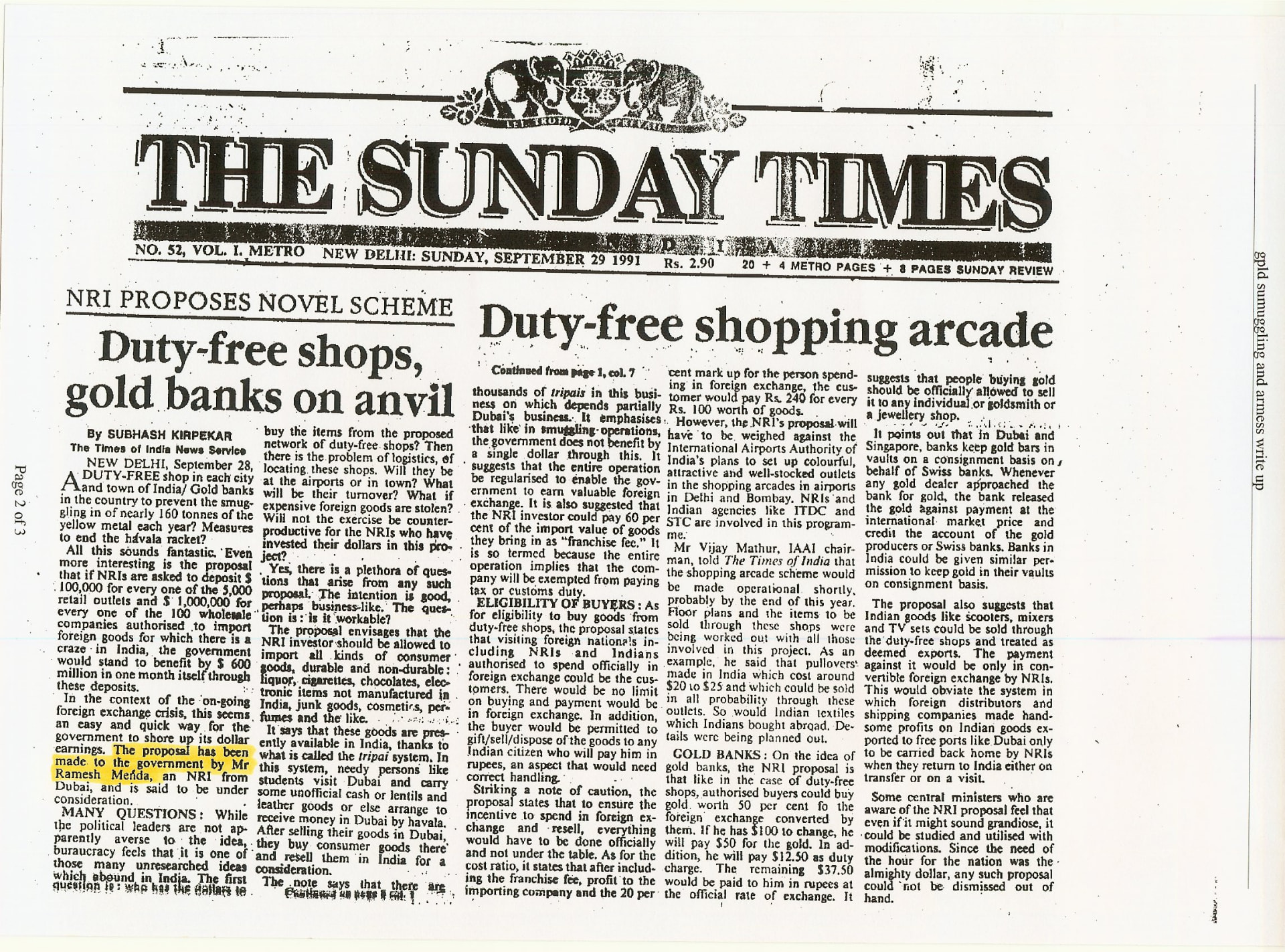
The Sunday Times of India, 29 September 1991 — Duty-free shops, gold banks on anvil
The Sunday Times of India, New Delhi29 September 1991
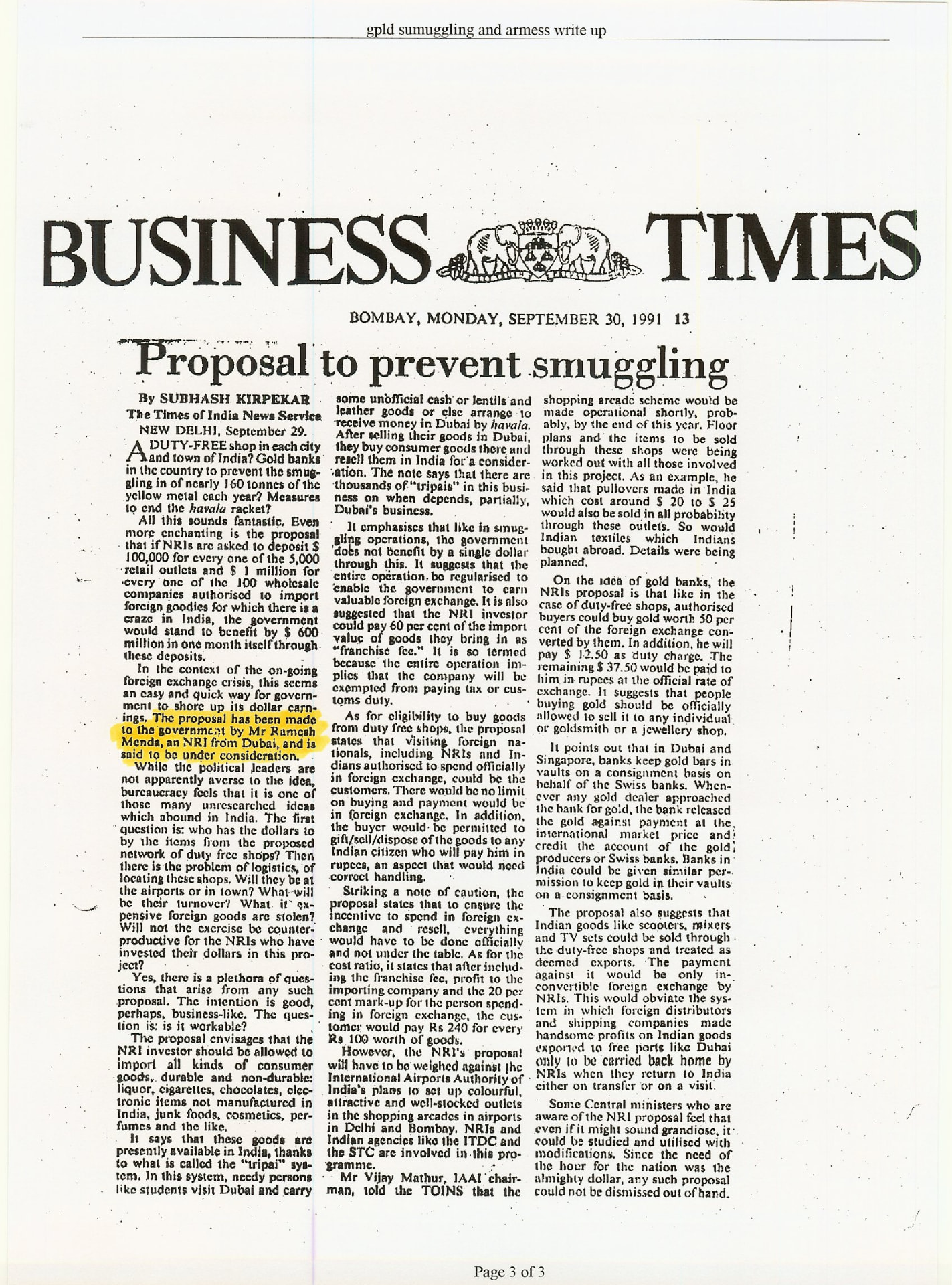
Business Times, 30 September 1991 — Proposal to prevent smuggling
The Times of India (Business Times), Bombay30 September 1991

Amid India's foreign exchange crisis, Ramesh Menda proposed a novel scheme: a duty-free shop in each city and town of India, and gold banks, to prevent the smuggling of nearly 160 tonnes of gold each year and end the havala racket. Under the proposal, NRI investors would deposit $100,000 for each of 5,000 retail outlets and $1 million for each of 100 wholesale companies — potentially raising $600 million in one month through these deposits alone.

The scheme envisaged NRI investors importing consumer goods — from electronics and liquor to cosmetics — for sale through the duty-free network to visiting foreign nationals, NRIs, and Indians authorised to spend foreign exchange, with buyers permitted to resell to Indian citizens paying in rupees. The proposal also suggested authorised buyers could purchase gold worth 50 per cent of their converted foreign exchange, paying a duty charge, with the remainder paid in rupees at the official rate.

Those aware of the proposal felt that even if it sounded grandiose, it could be studied and utilised with modifications — since, as the report noted, the need of the hour for the nation was the almighty dollar.

"The proposal has been made by Mr Ramesh Menda, an NRI from Dubai, and is said to be under consideration."

— The Sunday Times of India, 29 September 1991
May 1988

Appointed to NRI High Level Committee

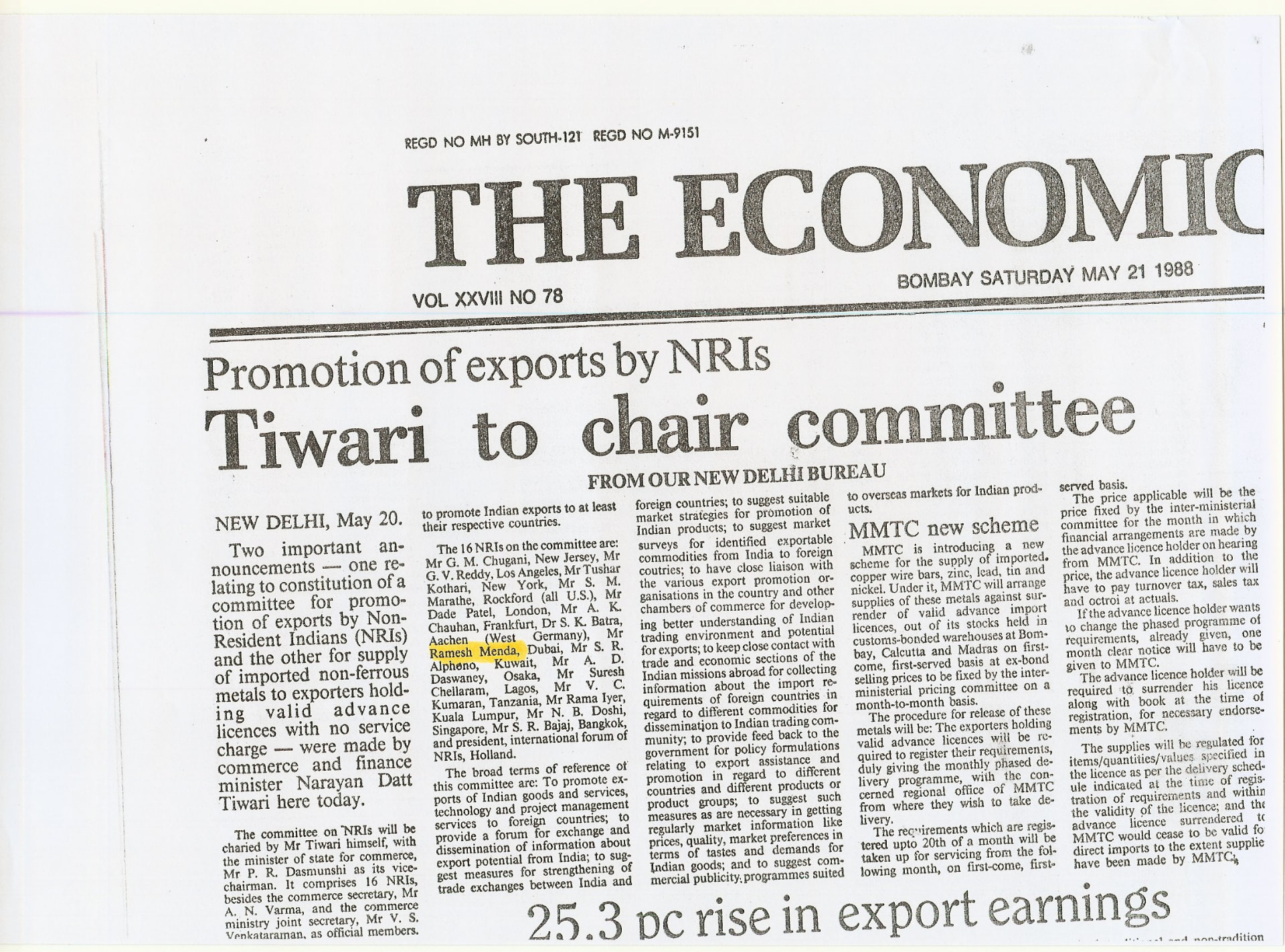
The Economic Times, 21 May 1988 — Promotion of exports by NRIs: NRI High Level Committee
The Economic Times, Bombay21 May 1988
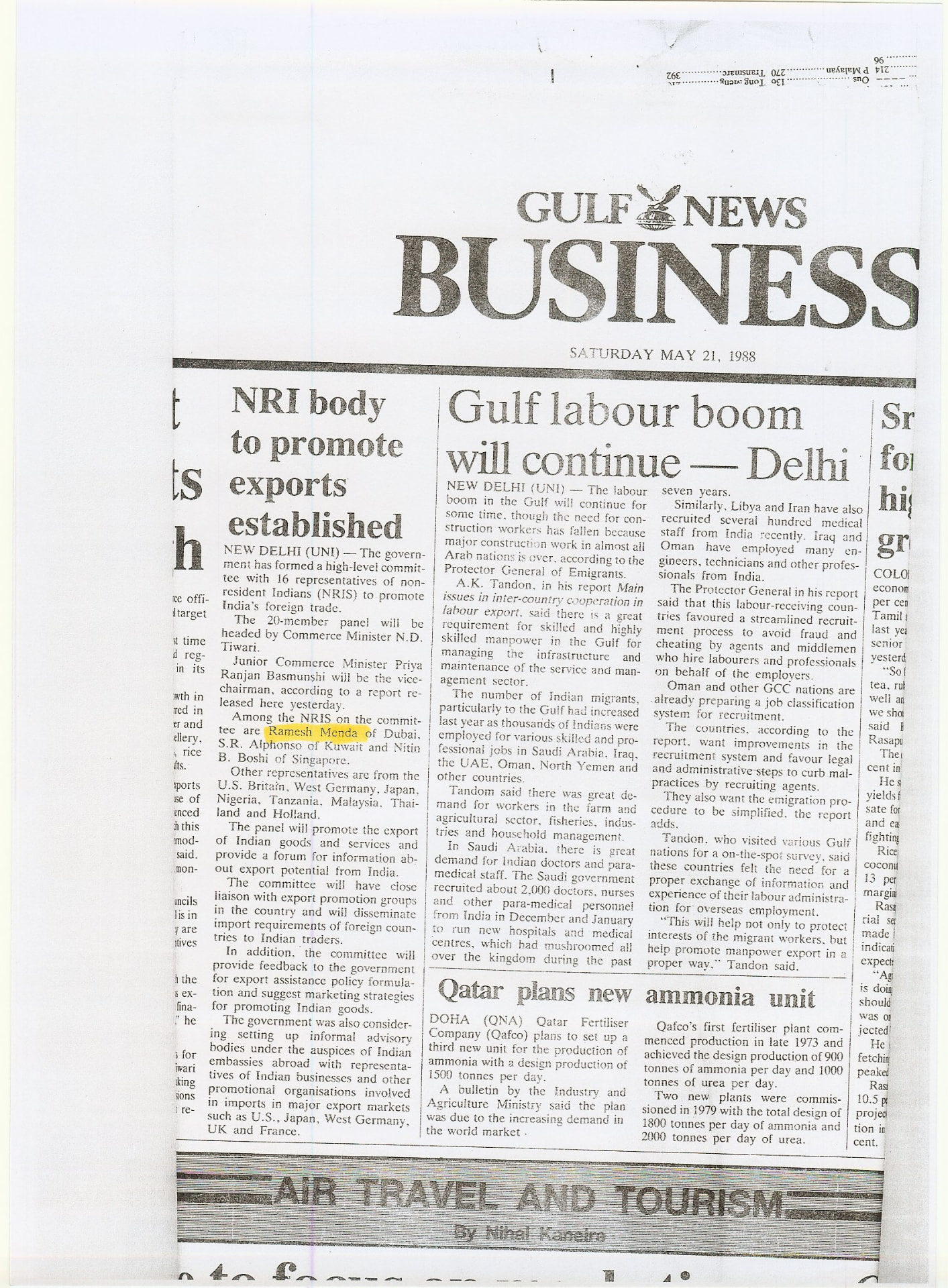
Gulf News Business, 21 May 1988 — NRI body to promote exports established
Gulf News21 May 1988
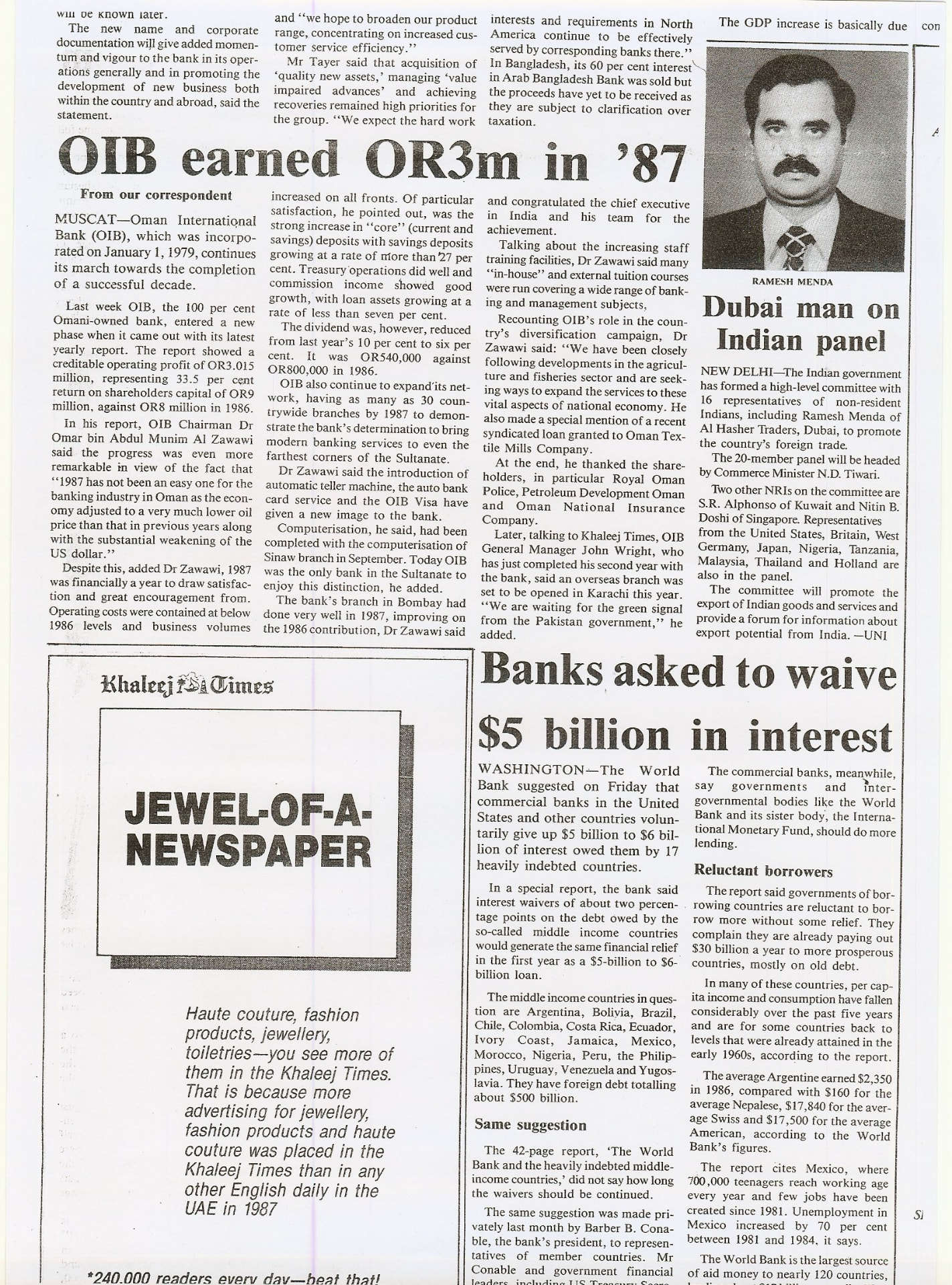
Khaleej Times — Dubai man on Indian panel, with a portrait of Ramesh Menda
Khaleej Times1988

Ramesh Menda was appointed to the NRI High Level Committee, which brought together 16 representatives of non-resident Indians to promote the country's foreign trade. 

The committee's terms of reference included promoting exports of Indian goods and services, technology and project management services to foreign countries, providing a forum for exchange of information about export potential from India, and suggesting market strategies for promotion of Indian products abroad.

The Times of India, the Economic Times, Gulf News, and the Khaleej Times all carried the announcement — the Khaleej Times running it under the headline "Dubai man on Indian panel" alongside his photograph.